
fbpx
A STEP CLOSER TO <span style="color: #F06B30;">PRECISE</span> <span style="color: #047491;">PRESCRIPTION</span>

A STEP CLOSER TO PRECISE PRESCRIPTION

Singapore Accreditation Council_Logo
First Clinical Recommended Genome-Wide Pharmacogenomics_Award
Largest Clinical Accredited Genome-Wide Pharmacogenomics_award

Featuring

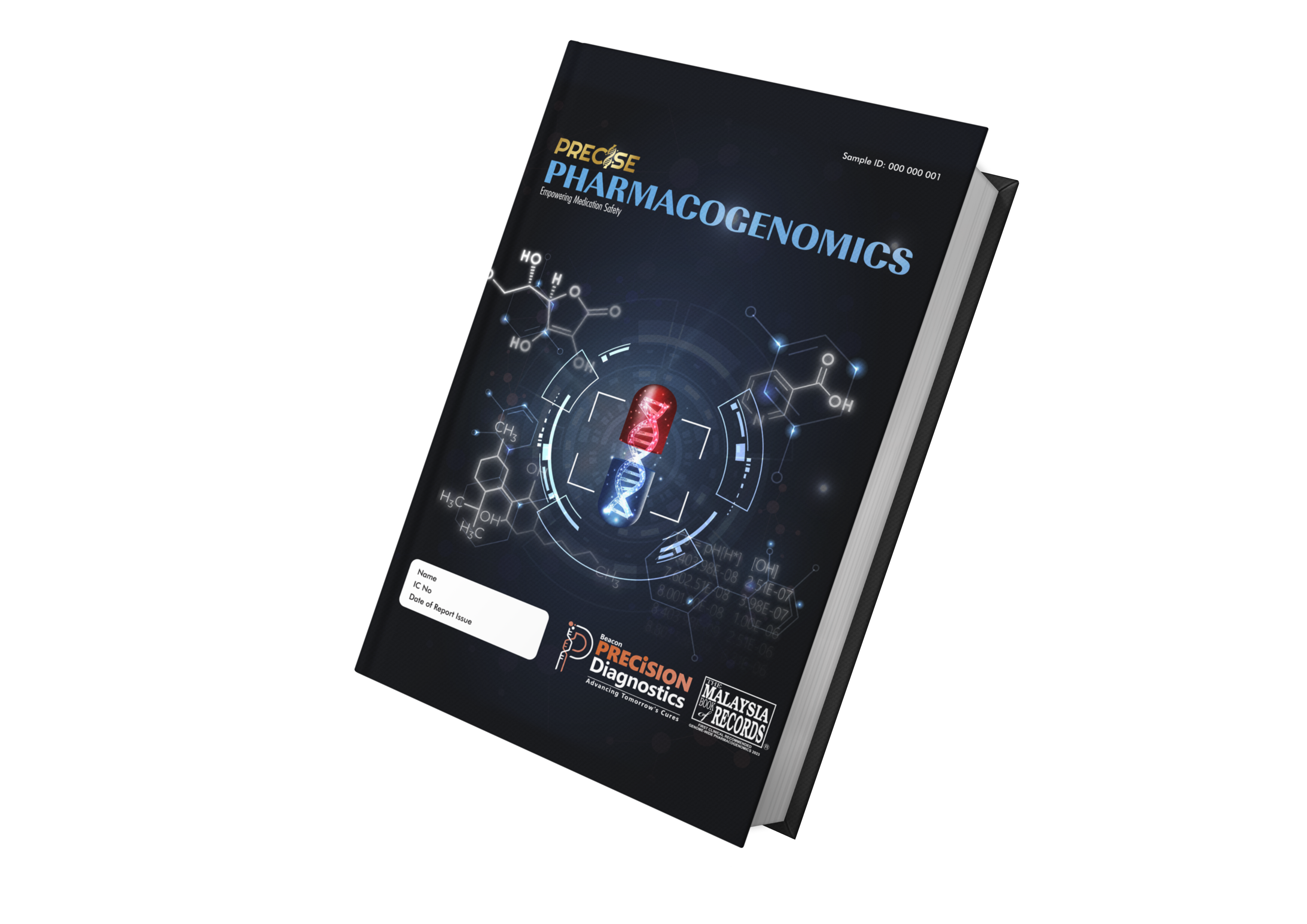
PRECISE Pharmacogenomics

Unlock the power of genome-wide technology to personalize your medication like never before. With PRECISE Pharmacogenomics, discover how your genetic makeup influences your response to medications. 

As a pre-emptive pharmacogenomics test, it provides clinically backed recommendations, empowering healthcare providers to prescribe safer, more effective treatments tailored just for you.

What Is Pharmacogenomics (PGx)?

Pharmacogenomics, otherwise abbreviated as PGx, is the study of how your genes influence your response to medication. Just as everyone’s DNA is unique, so is the way we process medications or drugs.

By analyzing your genetic makeup, PGx helps predict which medications will be most effective, which may cause side effects, and what dosages suit you best — reducing trial and error for safer, more personalized treatments.

What's the difference?

Pre-emptive vs. Reactive Pharmacogenomics

CHARACTERISTICS PRE-EMPTIVE PHARMACOGENOMICS REACTIVE PHARMACOGENOMICS
TIMING
Done before prescribing medication.
Done after an adverse reaction or treatment failure.
APPROACH
PROACTIVE – helps doctors select the safest, most effective medication upfront, reducing side effects.
REACTIVE – testing is only done in response to medication issues.
EXAMPLE
A patient scheduled for long-term medication (e.g., for high blood pressure) undergoes testing to ensure the best drug choice.
A patient suffers severe side effects from a painkiller. Testing later reveals poor drug metabolism, prompting a prescription change.
BENEFIT /LIMITATION
BENEFIT: Reduces trial and error, enhances treatment success.
LIMITATION: The patient experiences adverse (negative) effects before adjustments are made.

Why Pharmacogenomics?

Unlocking Safer, More Effective Medications With Pharmacogenomics

Adverse drug reactions remain a major global concern, but pharmacogenomics offers a groundbreaking solution. By understanding how your genes influence drug response, we can reduce trial-and-error prescribing and improve treatment outcomes. Here’s why pharmacogenomics testing matters;

How does it benefit me?

Benefits Of Pharmacogenomics (PGx):
Enhancing Treatment Precision

By using pharmacogenomics, you can get safer, more effective, and cost-efficient treatments that are tailored to your unique genetic makeup.

improvement in medication adherence when PGx testing guides treatment

7.6% Improvement

in medication adherence when PGx testing guides treatment ².

cost savings on medication

Cost savings on medication

by avoiding ineffective treatments and unnecessary prescriptions ³ ⁴.

trial and error prescribing healthcare

Reduced trial-and-error prescribing

benefiting healthcare providers and mental health therapies ⁵.

How does it work?

How Pharmacogenomics Works

Your body processes medications through AbsorptionDistribution, Metabolism, and Excretion (ADME). These steps determine how well a drug works and whether you might experience side effects.

Pharmacogenomics analyzes your DNA to see how fast or slow your body breaks down medications. Based on your genes, you may be;

Poor Metabolizer

Poor
Metabolizer

Your body processes the drug too slowly, increasing the risk of side effects.

Intermediate Metabolizer

Intermediate
Metabolizer

You process drugs slightly slower, so adjustments may be needed.

Normal Metabolizer

Normal
Metabolizer

You break down drugs at the expected rate, so standard doses usually work well.

Ultra Rapid Metabolizer

Rapid or Ultra-Rapid Metabolizer

Your body breaks down the drug too quickly, making it less effective.

Knowing your metabolizer type helps doctors choose the right medication and dosage for you, reducing side effects and guesswork.

Why Choose PRECISE Pharmacogenomics?

  • Cutting-Edge Technology

    Utilizes advanced genome-wide tech for in-depth insights, comparable to Biobank UK.

  • Extensive Marker Coverage

    Covers 100,000 ADME markers for drug metabolism.

  • Broad Gene Coverage

    Analyzes 1,000 genes for over 500 medications.

  • Regulatory Alignment

    Complies with FDA standards.

  • Clinically Accredited

    Accredited by; HSA for Clinical Recommendation of Targeted Treatment & ISO13485:2016 by UKAS

  • Award-Winning

    "First Clinical Recommended Genome-Wide Pharmacogenomics" by the Malaysian Book of Records.

⚠️ Only Clinically Accredited DNA test can be used by healthcare professionals to make important treatment decisions.
PRECISE PHARMACOGENOMICS (PGx)

Book An Appointment Today!

Personalize your medication, minimize side effects, and optimize treatment with
PRECISE Pharmacogenomics.

PRECISE Pharmacogenomics

Real Stories, Real Impact

How PRECISE Pharmacogenomics Is Changing Lives

Click any of the following to find out more about how PRECISE Pharmacogenomics is making a difference.

Case Study A - A Life-Saving Discovery in Heart Health

A 55-year-old man had been taking clopidogrel for over 10 years, believing it was working well. However, PRECISE PGx testing revealed that his body didn’t process the drug effectively, making it less protective. Soon after, he started experiencing mild chest discomfort. Further tests showed a dangerous 90% blockage in his arteries, requiring an urgent stent procedure and a switch from clopidogrel to ticagrelor. Thanks to PGx-guided treatment, he recovered within a week and has remained stable for over a year.

Meanwhile, a 49-year-old woman who had been on clopidogrel for six years took the PGx test and was relieved to find that her body processed the drug well, and her arteries were clear. This gave her peace of mind and reinforced her commitment to staying on her prescribed treatment.

Case Study B - Preventing Stroke With the Right Medications

A 60-year-old man with high blood pressure and atrial fibrillation (AF) suffered a mini-stroke (TIA) just one month after taking the PRECISE PGx test. Luckily, the test results were ready when he needed them, allowing his doctors to;

* Prescribe the right antiplatelet drug (clopidogrel), based on his CYP2C19 result

* Adjust his warfarin dose to prevent bleeding issues

* Switch his cholesterol medication from atorvastatin to rosuvastatin to avoid side effects

As a result, he fully recovered within a week, and his cholesterol dropped to a healthy level within six weeks — all while experiencing less muscle pain.

Case Study C - Solving a 20-Year Hypertension Mystery

A 61-year-old woman had struggled with high blood pressure for 20 years. Despite taking the maximum dose of Losartan (100 mg), her readings remained high (145/92 mmHg) and would sometimes spike dangerously to 180 mmHg.

She took the PRECISE PGx test, which revealed that Losartan wasn’t effective for her genetic profile. Her doctor switched her to Telmisartan (80 mg) instead. The result? Her blood pressure dropped to a healthy 127/72 mmHg within a day. Her headaches disappeared, and she has remained stable for over a year.

Note: Please click on this image to view the case study details.

How to start?

How To Get Started With Your PRECISE Pharmacogenomics Test

Step 1

Contact Precision Diagnostics or visit your nearest PRECISE Pharmacogenomics panel to obtain your test

Step 2

Choose the collection method between a buccal swab (self-administered) or a blood draw (requires an appointment) at a designated facility.

Step 3

Your sample is sent to the Precision Diagnostics' laboratory for processing.

Step 4

Your results will be ready in 4 to 6 weeks. You'll receive an email and SMS notification once your report is available in our app, PreciseEHR.

Step 5

Book your complimentary one-on-one consultation with a healthcare professional to review your results.

Get Your Test Kit

Contact Precision Diagnostics or visit your nearest PRECISE Pharmacogenomics panel to obtain your test.

Collect Your Sample

Choose the collection method between a buccal swab (self-administered) or a blood draw (requires an appointment) at a designated facility.

Lab Analysis

Your sample is sent to the Precision Diagnostics’ laboratory for processing.

Receive Your Report

Your results will be ready in 4 to 6 weeks. You’ll receive an email and SMS notification once your report is available in our app, PreciseEHR.

Consult with an Expert

Book your complimentary one-on-one consultation with a healthcare professional to review your results.

available now

Go Paperless With PreciseEHR

Take charge of your health with PreciseEHR, your secure electronic health record (EHR) platform. Access your Pharmacogenomics report, track your health data, and stay informed—all in one place.

one-to-one personalized consultation

PRECISE Pharmacogenomics
Doctor Panel

Get a personalized one-to-one consultation with our expert doctors to help you understand your pharmacogenomic report

Dr. Nada Syazana Zulkufli

MBBS (Monash), MRCPI (Ireland), MPATH (Chemical)(UM), AM (Mal)

Hoo Fan Kee

Assoc. Prof. Dr. Hoo Fan Kee

MD (Mal), MRCP (UK), MRCPS (Glasgow)

Frequently Asked Questions

What is the difference between DNA testing and Pharmacogenomics?

DNA testing, or genetic testing, comes in many forms, including tests for ancestry, relationships, inherited diseases, cancer risks, and medical diagnoses. These tests analyze your genes, chromosomes, or proteins to detect genetic conditions, assess disease risk, or determine hereditary traits.

Pharmacogenomics (PGx), on the other hand, focuses specifically on how your genes affect your response to medications. It helps healthcare professionals personalize treatment plans, reduce the risk of adverse drug reactions (ADRs), optimize drug selection and dosage.

While genetic testing can help identify potential health risks, PRECISE Pharmacogenomics (PGx) ensures that your medications are tailored specifically for you—enhancing safety and treatment effectiveness.

Is PRECISE Pharmacogenomics reliable?

Yes. PRECISE Pharmacogenomics (PGx) provides comprehensive genome-wide coverage, analyzing nearly 100,000 ADME markers and over 1,000 genes, covering more than 500 commonly used medications, including:

  • Painkillers
  • Antibiotics
  • Diabetes medications
  • Heart disease treatments
  • Cancer therapies

Awarded as “The First Clinical Recommended Genome-Wide Pharmacogenomics” by the Malaysia Book of Records, this DNA report is user-friendly. Only certified healthcare professionals are qualified to interpret the report to provide clinical recommendations, diagnoses, and treatment plans. Please note that this report does not replace a medical consultation with your doctor.

How accurate is PRECISE Pharmacogenomics?

PRECISE Pharmacogenomics (PGx) boasts an analytical accuracy of over 99%, making it one of the most precise and reliable pharmacogenomics test available. Our platform is backed by PRECISE Pharmacogenomics (PGx) boasts an analytical accuracy of over 99%, making it one of the most precise and reliable pharmacogenomics test available. Our platform is backed by CAP & ISO 15189 laboratory compliance for high accuracy and quality. standards.

Who should consider getting a PRECISE Pharmacogenomics test?

PRECISE Pharmacogenomics test is beneficial for both people who are currently taking medications (reactive testing) and those who want to be proactive and prepare before starting new medications (pre-emptive testing). It’s designed to find the right medication at the right dose for you. This test is especially recommended for:

  • Individuals on long-term medications (e.g., hypertension, diabetes, mental health conditions).
  • People taking multiple medications (e.g., for chronic or complex health issues).
  • Those with a history of medications side effects and/or found treatment ineffective.
  • Individuals who want to ensure their medications are both safe and effective.
  • Anyone who is proactive and have their genetic-drugs information ready to guide future prescriptions, so doctors can choose the right medication from the start, even in emergencies, acting as “genomic insurance.”
Can children or elderly individuals take the PRECISE Pharmacogenomics test?

Yes! PRECISE Pharmacogenomics testing is suitable for all ages and can be especially beneficial for:
• Children – Helps identify potential drug responses early, ensuring safer and more effective treatments as they grow.
• Elderly individuals – Particularly useful in managing multiple medications, reducing the risk of medication side effects and ensuring medications are tailored for safer use.

Because your genetic blueprint remains the same for life, the PRECISE Pharmacogenomics test is a once-in-your-lifetime test that provides lifelong value. Your DNA results can guide safe and effective medication choices for the rest of your life.

Does my pharmacogenomics result change over time?

No. Your genetic blueprint does not change over time, meaning your pharmacogenomics results remain valid for life. However, as new medications and research emerge, updates may be available to enhance treatment recommendations.

PRECISE PHARMACOGENOMICS (PGx)

Book An Appointment Today!

Personalize your medication, minimize side effects, and optimize treatment with
PRECISE Pharmacogenomics.

PRECISE Pharmacogenomics

References:

  1. Oster H, Chaves I. Effects of Healthy Lifestyles on Chronic Diseases: Diet, Sleep and Exercise. Nutrients. 2023 Oct 31;15(21):4627. doi: 10.3390/nu15214627. PMID: 37960280; PMCID: PMC10650398.
  2. Shang, X., Liu, J., Zhu, Z. et al.Healthy dietary patterns and the risk of individual chronic diseases in community-dwelling adults. Nat Commun 14, 6704 (2023). https://doi.org/10.1038/s41467-023-42523-9
  3. Bösch ES, Spörri J, Scherr J. Vitamin Metabolism and Its Dependency on Genetic Variations Among Healthy Adults: A Systematic Review for Precision Nutrition Strategies. Nutrients. 2025 Jan 10;17(2):242. doi: 10.3390/nu17020242. PMID: 39861372; PMCID: PMC11767394.
  4. Madeo G, Donato K, Micheletti C, Cristoni S, Miertus S, Miertus J, Veselenyiova D, Iaconelli A, Aquilanti B, Matera G, Connelly ST, Bertelli M. Nutrigenomics: SNPs Correlated to Lipid and Carbohydrate Metabolism. Clin Ter. 2023 Nov-Dec;174(Suppl 2(6)):200-208. doi: 10.7417/CT.2023.2488. PMID: 37994765.
  5. Laddu D, Hauser M. Addressing the Nutritional Phenotype Through Personalized Nutrition for Chronic Disease Prevention and Management. Prog Cardiovasc Dis. 2019 Jan-Feb;62(1):9-14. doi: 10.1016/j.pcad.2018.12.004. Epub 2018 Dec 13. PMID: 30553801.
  6. Karvela, M., Golden, C.T., Bell, N. et al.Assessment of the impact of a personalised nutrition intervention in impaired glucose regulation over 26 weeks: a randomised controlled trial. Sci Rep 14, 5428 (2024). https://doi.org/10.1038/s41598-024-55105-6
  7.