Home>Blogs>Brief Overview of the Emergency of Pharmacogenetics
Brief Overview of theEmergency of Pharmacogenetics
4 July 2024
Pharmacogenetics isn’t just some scientific jargon; it’s the future of medicine that’s changing how we use drugs. Back in the day, doctors noticed that not everyone responds the same way to medications. They figured out that our genes play a big role in this. This discovery rocked the world of medicine and how we treat diseases with drugs. From the early days of understanding how genes affect our reactions to drugs to using genetic info to help doctors treat patients better, pharmacogenetics is reshaping how we think about medicines.
It’s promising better and safer treatments, not just for some, but for folks all around the globe. In this overview, we embark on a journey through the history and evolution of pharmacogenetics, shedding light on the key milestones and developments that have propelled it into the forefront of personalised medicine. ¹ ⁶
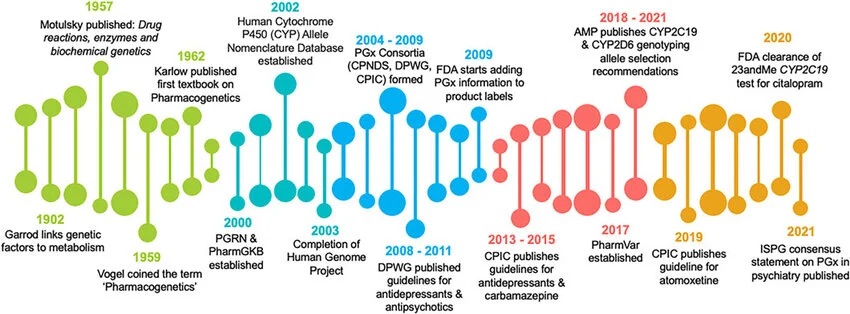
Reference - Psychological Medicine, Cambridge University Press (2023). 53(16):1-11
During the 1950s
1950s - 1960s: Early Investigations
The concept of pharmacogenetics began gaining attention as researchers observed individual variations in drug responses.
Studies focused on understanding why some patients experienced adverse reactions while others benefited from medications.
In 1957, The term “pharmacogenetics” was coined by Friedrich Vogel. Early studies focused on genetic differences in enzyme activity, such as variations in acetylation affecting drug metabolism. ² ³
Reference: Picture of Friedrich Vogel, Heidelberg (ResearchGate)
1970s - 1980s: Genetic Variations and Drug Metabolism
Researchers identified genetic differences in drug-metabolizing enzymes, particularly the cytochrome P450 (CYP450).
Genetic polymorphisms (variation in our genes) were linked to variations in drug metabolism rates, affecting drug efficacy and toxicity.
Notable discoveries included the genetic basis for poor metabolizers of certain drugs like Debrisoquine (a medication that is primarily used to lower blood pressure and treat irregular heart rhythms).
Advances in molecular biology allowed for the identification of specific genetic variants. Studies linked polymorphisms in CYP2D6 to variable drug metabolism rates, influencing drug efficacy and safety. ⁴ ⁵ ⁶
1990s: Genetic Basis for Drug Responses
The Human Genome Project , initiated in the late 1980s and completed in the early 2000s, provided a wealth of genetic information.
Researchers began identifying specific genetic variants associated with drug responses, including variations in drug targets and receptors.
The term “pharmacogenetics” became more widely used to describe the study of genetic influences on drug responses. ⁷
Photo Reference: Robert Waterston, M.D., Ph.D., at the 2001 press conference announcing the publication describing the draft sequence of the human genome generated by the Human Genome Project. Dr. Waterston was an instrumental planner, prominent leader, and major participant of the Human Genome Project. (NHGRI Photo Archive)
During the 2000s
2000s: Translational Advances and Clinical Implications
Advances in genotyping technologies and DNA sequencing allowed for more comprehensive studies of genetic variants linked to drug responses.
Pharmacogenetic testing gained attention for its potential to guide personalised medicine.
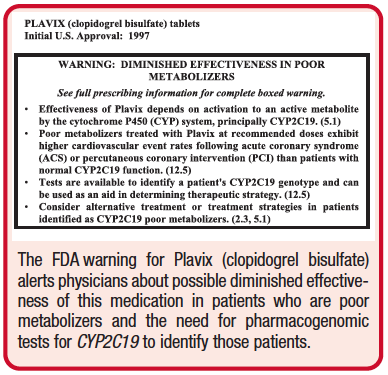
Regulatory agencies like the U.S. FDA started incorporating pharmacogenetic information into drug labels because the completion of the The Human Genome Project in 2003 provided a wealth of genetic information, facilitating the identification of pharmacogenetic markers. The FDA began to recognize the importance of pharmacogenetics in drug labeling, leading to more personalised medicine. ⁸ ⁹
2010s: Integration into Clinical Practice
Pharmacogenetics transitioned into the broader field of pharmacogenomics, incorporating genomics and molecular biology.
Many hospitals and healthcare systems integrated pharmacogenetic information into electronic health records (EHRs) to aid decision-making.
The clinical implementation of pharmacogenetic testing grew, with tests guiding drug dosing, selection, and avoiding adverse reactions.
Research expanded to identify genetic markers for drug-induced side effects, optimal treatment outcomes, and cancer therapies. ¹⁰ ¹¹
From Discovery to Clinical Practice
The emergence of pharmacogenetics has transformed our understanding of why individuals may respond differently to the same medication. What began as observations of genetic variation in drug response has evolved into a rapidly growing field that supports more personalised healthcare.
Today, pharmacogenomic testing can provide healthcare professionals with additional insights into how genetic differences may influence medication metabolism and response. These insights may help support more informed prescribing decisions and reduce the trial-and-error approach often associated with medication selection.
PRECISE Pharmacogenomics (PRECISE PGx) analyses clinically relevant genetic markers associated with medication metabolism and response. By providing actionable genetic insights, PRECISE PGx supports a more personalised approach to medication management across a wide range of therapeutic areas.
With analytical accuracy exceeding 99.99%, PRECISE PGx evaluates clinically relevant pharmacogenomic markers associated with more than 500 medications, helping healthcare professionals gain additional information when evaluating treatment options.
Kalow, W. (2006). Pharmacogenetics and pharmacogenomics: Origin, status, and the hope for personalized medicine. Pharmacogenomics Journal, 6(3), 162-165. DOI: 10.1038/sj.tpj.6500367
Vogel, F. (1959). Moderne Probleme der Humangenetik. Ergebnisse der Inneren Medizin und Kinderheilkunde, 12, 52-125. DOI: 10.1007/978-3-642-94909-1_1
Meyer, U. A. (2004). Pharmacogenetics—five decades of therapeutic lessons from genetic diversity. Nature Reviews Genetics, 5(9), 669-676. DOI: 10.1038/nrg1428
Nebert, D. W., & Dalton, T. P. (2006). The role of cytochrome P450 enzymes in endogenous signalling pathways and environmental carcinogenesis. Nature Reviews Cancer, 6(12), 947-960. DOI: 10.1038/nrc2015
Weinshilboum, R. M., & Wang, L. (2004). Pharmacogenomics: Bench to bedside. Nature Reviews Drug Discovery, 3(9), 739-748. DOI: 10.1038/nrd1470
Evans, W. E., & Relling, M. V. (1999). Pharmacogenomics: Translating functional genomics into rational therapeutics. Science, 286(5439), 487-491. DOI: 10.1126/science.286.5439.487
The International HapMap Consortium. (2005). A haplotype map of the human genome. Nature, 437(7063), 1299-1320. DOI: 10.1038/nature04226
Relling, M. V., & Klein, T. E. (2011). CPIC: Clinical Pharmacogenetics Implementation Consortium of the pharmacogenomics research network. Clinical Pharmacology & Therapeutics, 89(3), 464-467. DOI: 10.1038/clpt.2010.279
U.S. Food and Drug Administration. (2007). FDA Requires Labeling Changes to Warn of Risk for Genetic Variation. Retrieved from FDA website
Manolio, T. A., et al. (2015). Implementing genomic medicine in the clinic: the future is here. Genetics in Medicine, 17(11), 733-740. DOI: 10.1038/gim.2015.47
Dunnenberger, H. M., et al. (2016). Clinical pharmacogenetics implementation consortium (CPIC) guideline for CYP2C19 and clopidogrel therapy: 2013 update. Clinical Pharmacology & Therapeutics, 89(3), 464-467. DOI: 10.1002/cpt.204